Posts

Day 299 - Gilded Age Portraits

Image
 May 21, 2022 Gallery 771 is devoted to portraiture during the Gilded Age. The artists on display depicted their subjects in various ways. One common element, the signage notes, is the influence of Velazquez, evident in the shallow,  monochrome backgrounds from which figures emerge in silhouette.  I wonder to what extent the Spanish painter's influence was transmitted through Manet, who revered Velazquez and whom at least some of the Americans met when studying in Paris. Three paintings especially impress me. John Singer Sargent's "The Wyndham Sisters: Lady Elcho, Mrs. Adeane, and Mrs. Tennant," executed in 1899, is truly portraiture in the grand style, and on the grand  scale, too - perhaps 12 feet high and 9 feet wide. The figures occupy only the bottom part of the canvas. Two of the sisters sit side by side on a divan. The third stands behind, her body turned away in three-quarter view, the better to show off her long, elegant nose and Sargent's adeptness in pa...

Day 298- Sargent in Egypt

Image
 May 12, 2022 Gallery 770 is devoted to works by American Impressionists. In truth, most of them don't strike me as all that Impressionist, or as all that noteworthy.  I am, however, interested to learn that John Singer Sargent, several of whose canvases hang here, met Monet in 1876 and was inspired to experiment with the style. Furthermore, while I had always thought of Sargent as the quintessential society painter, it turns out that he also painted people at work.  One of his paintings depicts quarrymen at Carrara.  Another, the subject of today's entry, is entitled "Egyptians Raising Water from the Nile." According to the signage, Sargent received a commission to paint a mural cycle for the Boston Public Library and decided that its theme would be the history of religion - by which, as a Google search reveals, he meant Near Eastern religions (Egyptian and Assyrian belief systems, Judaism, Christianity). Google also tells me that one of the murals provoked consider...

Day 297 - Childe Hassam

Image
May 9, 2022 Gallery 769 displays works painted between 1880 and 1920 by American Impressionists (especially William Merritt Chase and Childe Hassam) and Realists (notably, George Bellows and Rockwell Kent). Two Hassam works are the subject of today's entry. I love them both, for different reasons. Who wouldn't love "Celia Thaxter's Garden, Isle of Shoals, Maine"?  A luxuriant field of wildflowers occupies the foreground of this small painting (perhaps 24" long X 18" high), which Hassam painted in 1890. Bright red poppies capture the eye and contrast with the beige of the rocky coast and the blue of sea and sky in the background. The picture is at once serene and vibrant; Hassam's training as an Impressionist is evident. The artist painted "The Church at Gloucester" some 30 years later, in 1918; its style is more realistic. In the work (which measures about 28" high and 24" wide), a pathway lined by tall trees that cast soft shadow...

Day 296 - Depictions of women

Image
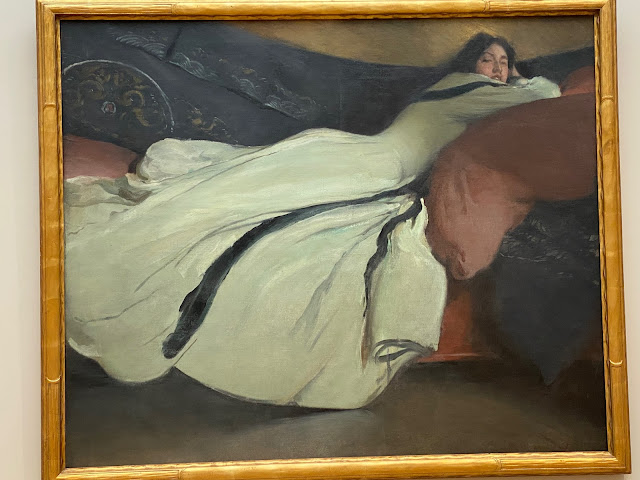
May 5, 2022 Gallery 768 is home to paintings and sculptures that exemplify a popular subject for American artists at the turn of the 20th century: upper-class women, sometimes accompanied by their children, in well-appointed settings and at leisure (of which, given the plethora of domestic servants, they must have had a great deal).  Many of the works are straightforward, but a couple strike  me as curious. One of these is a large oil painting (perhaps five feet wide and four feet high) by JohnWhite Alexander completed in 1895 and entitled "Repose." A single figure occupies most of the canvas: a woman in a white dress stretched out  on  a divan, her upper body resting on a rose-colored pillow.The placard  notes that Alexander lived in Paris during the 1890s and "achieved international success with his studies of female figures gracefully posed in elegant interiors."  It goes on to say that the work reflects the contemporary French taste for sensual images o...

Day 295 - Walker on Leutze

Image
April 28, 2022 Gallery 767 is home to works by three contemporary African-American artists, Kara Walker, Kerry James Marshall, and Hugh Hayden, that reflect on two icons of American painting in the Met's collection: Emmanuel Leutze's "Washington Crossing the Delaware," which hangs in the adjacent gallery, and Winslow Homer's "The Gulf Stream," part of a major show on Homer that's currently at the museum. For me, Kara Walker's "The Crossing," an outsize diptych that  measures approximately 12 feet long and 7 feet high, is by far the most impressive item on display, and unquestionably the most hard-hitting.  According to the placard, she began this take-off on the Leutze painting on January 20, 2017,  the day of Trump's inauguration, and the work expresses her anger and anguish about that event.  The drawing is largely in black and white, with a few notable exceptions: the red, white, and blue of the American flag, the blue of the wat...

Day 294- Charles Grafly portrait bust of Henry Ossawa Tanner

Image
 April 21, 2022 The title of the sign introducing gallery 766 is "The Cosmopolitan Spirit, 1860-1900," although again, the timeframe is only approximate.  The gallery shows works by artists who lived in Europe or traveled widely in other countries. These works include a couple of Orientalist paintings, which seem obligatory in a gallery with this theme. along with a Whistler and a Ryder.  The majority of these painters, though, I've never heard of.  One whose name - but little more -  I did know is Henry Ossawa Tanner. Tanner, I learn, spent his latter years in France, in part to escape racism in this country.  One of his paintings is on display, a "Flight Into Egypt"; the setting Tanner depicts is not the conventional desert scene but a narrow urban alley. According to the placard, in his later years, Tanner turned to Biblical themes, which must have been instilled in him in childhood; his father was a bishop in the  A.M.E. Church.   Today's obje...

Day 293 - Remington

Image
April 18, 2022 The placard introducing gallery 765 describes its holdings as dealing with the American West between 1860 and 1920.  In fact, several of the works on exhibit were made after that period. These include an iconic 1930 Georgia O'Keeffe painting of Ranchos Church in Taos; an Ernest Blumenschein landscape of Taos Valley painted in 1933 that is distinctive for its geometric forms and rich color contrasts; and a striking jar made in 1990 by Nathan Begaye, a Hopi-Navajo ceramist and painter, that depicts the sun god both as a traditional katsina and as a nude man whose well-muscled, triangular torso, six-pack abs, pubic hair, and genitals are on full frontal display. (I note that the Met has been diligent about using "katsina" rather than "kachina," but has not similarly substituted Dine' for Navajo - presumably because relatively few people would know the tribe's name for itself.)  Works seem to fit into this gallery because of their subjects, no...